Roodepoort, Johannesburg, 1709
DebiPay- Smart, Secure Debit Order Collections Made Simple


Writer
Securing payment data is vital for small and medium businesses. DebiPay uses tokenisation to replace sensitive card details with secure tokens, protecting transactions from fraud and breaches. In this post, we’ll explain how tokenisation works, why it matters, and how services like TaaS, reduction, and detokenisation make payments safer and simple
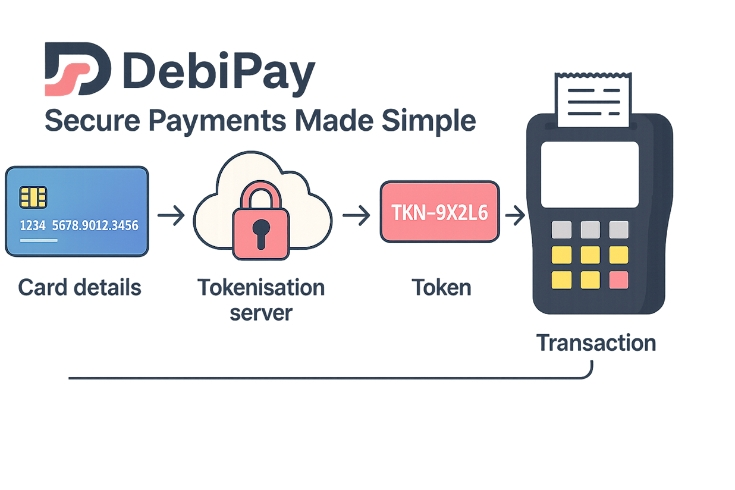
Tokenisation is a security technique that replaces sensitive data with a non-sensitive equivalent called a token. This token has no intrinsic value and cannot be used outside the system that generated it. When your customer makes a payment using DebiPay, your actual card details are never stored or transmitted in plain text. Instead, they are substituted with a randomly generated token, which acts as a stand-in during transactions.
This significantly reduces the risk of data breaches because even if someone intercepts the data, they only see meaningless tokens, not your actual information.
Tokenisation plays a big role in making subscription payments secure and convenient. Here’s how it supports subscriptions:
Secure Storage for Recurring Charges
Instead of storing a customer’s actual card details, businesses store a token—a randomly generated identifier linked to the card. This means sensitive data never resides on your servers, reducing the risk of breaches.
Seamless Recurring Billing
Tokens can be reused for future transactions without asking the customer to re-enter their card details. This enables automatic monthly, quarterly, or annual billing for subscriptions.
Fraud Prevention
Even if a token is intercepted, it’s useless outside the original payment environment because it doesn’t contain real card data. This keeps recurring payments safe from fraudulent use.
Compliance and Reduced Liability
Tokenization helps businesses meet PCI DSS requirements by minimising exposure to sensitive payment data, which is critical for subscription-based models.
Customer Experience
Subscribers enjoy a frictionless experience—sign up once, and payments happen automatically without repeated input, while still maintaining security.
Tokenisation is widely adopted across the payment ecosystem:
DebiPay uses tokenisation as part of its core security framework, enabling you to process payments without ever handling sensitive card data directly.
Here’s the technical flow:
Even if intercepted, these tokens cannot be reverse-engineered to reveal actual card details.
TaaS is a cloud-based solution that allows businesses to outsource tokenisation. Instead of building and maintaining their own tokenisation infrastructure, companies can:
Providers like Graviti Pay offer TaaS to simplify adoption for SMEs and large enterprises.
Reduction refers to minimising the scope of PCI compliance by removing sensitive data from merchant systems. Tokenisation achieves this by ensuring merchants never store raw card data, reducing audit complexity and cost.
Detokenisation is the reverse process—mapping a token back to its original data in a secure, PCI-compliant environment. This is essential for:
Detokenisation must occur in a highly controlled environment to prevent exposure.
Graviti Pay leverages both strategies for comprehensive security.
Tokenisation is no longer optional—it’s a necessity for secure digital payments. By replacing sensitive data with meaningless tokens, businesses reduce fraud risk, simplify compliance, and protect customer trust. Advanced services like TaaS, reduction, and detokenisation ensure scalability and operational efficiency.
Whether you’re processing one-off payments or recurring billing, tokenisation keeps your data safe, your compliance costs low, and your customers confident.

